Every mosque display platform, compared honestly.
We build one of these, so treat everything here with appropriate suspicion — and then read the section on each page where we say what the other product does better. There is one on all of them.
How to read these pages
Most mosque committees arrive at this decision the same way: someone is asked to “sort out the screen”, they search for an hour, and every result is either a vendor saying it is the best or a directory site that has scraped an app store. Neither tells you the thing you need, which is what each product actually costs to run and what it does when nobody is looking at it.
So each page below covers the same five things: what hardware you have to buy, what happens during a Wi-Fi outage, who finds out when a screen goes dark, whether the features are included or itemised, and what three years of it costs with the assumptions written out. Then a section on where that product is better than ours.
The prices were checked in September 2026 against each vendor’s own published material. Where a vendor does not publish something, the table says so instead of guessing.
SalahClock vs Masjidal
Best known for the Athan Frame home clock. Its masjid product, Al-Iqamah, is a TV app with a free tier and a $20/mo Professional plan.
Choose Masjidal if You want screens, donation hardware and gift-shop athan clocks from a single supplier, and you are happy to run a TV box.
SalahClock vs MAWAQIT
Free forever, ad-free, run as an endowment. Runs as an Android TV or Raspberry Pi app, and requires your mosque to be verified before it goes live.
Choose MAWAQIT if Cost is the deciding factor, you have a technical volunteer, and your mosque is registered and public.
SalahClock vs Masjidbox
Screens, mobile apps and websites sold as separate modules. 2,500+ mosques and 17 languages, but the all-in bundle is €62/month.
Choose Masjidbox if You want the screen, the mobile app and the mosque website from one vendor, or you need a display language we do not carry.
SalahClock vs MOHID
The closest thing this market has to a masjid ERP. Displays are one module among many, starting at $99/month plus $100 per signage player.
Choose MOHID if You need donations, membership, classes and the masjid's accounts in one system, and the screen is a bonus.
SalahClock vs MASAJID
5,000+ mosques, 30+ features, 15+ calculation methods including Kemenag RI and JAKIM. Runs natively on Android TV, Raspberry Pi and mini PCs.
Choose MASAJID if You are in Indonesia or Malaysia, you want Kemenag RI or JAKIM out of the box, or you want video, livestream and ticker slides today.
SalahClock vs AzanCast
The closest product to ours: a URL on any TV, no hardware. Adds Stripe donations and a live Jumu'ah translation add-on; Pro is $169/year.
Choose AzanCast if Online donations through the display matter more than anything else, or you want live khutbah translation on congregants' phones.
SalahClock vs ConnectMazjid
A generous free tier — multiple TV displays, a website, ticketing and Stripe donations — but the prayer countdown and adhan audio are paid add-ons.
Choose ConnectMazjid if You want a masjid website, ticketed events and donations bundled in, or you need several committee members to have their own logins.
Common questions
What is the best mosque prayer-time display software?
Which mosque display software works without buying hardware?
Is there a genuinely free mosque prayer display?
Can a mosque display work without internet?
What should a mosque committee actually compare?
Why is SalahClock writing comparisons that recommend competitors?
The cheapest way to compare is to look at both.
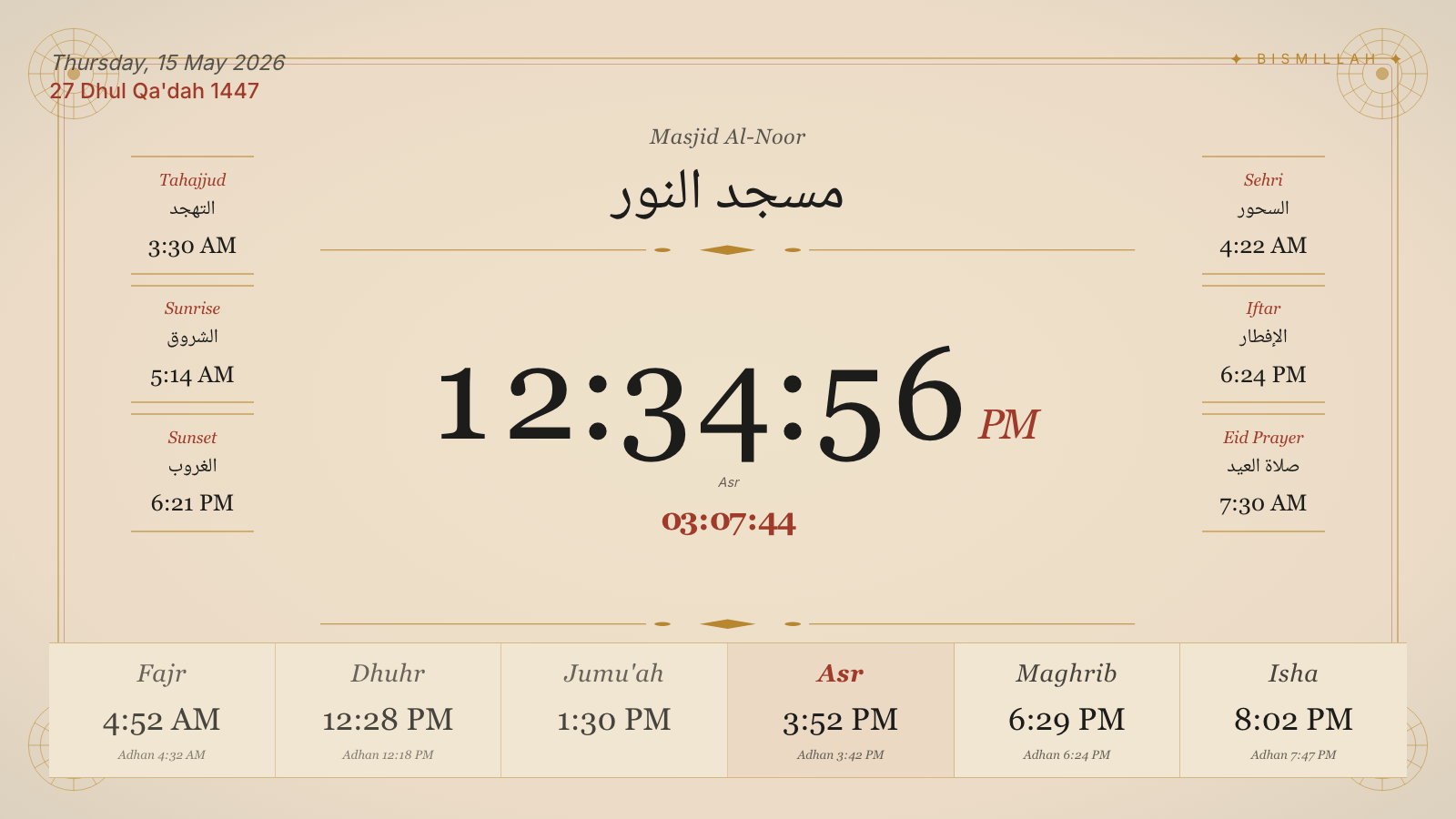
SalahClock needs no hardware and no card. Make a clock, open the URL on the hall TV next to whatever you run now, and let the committee decide with their eyes.
- No hardware
- No app to install
- Works offline
- Free forever for one clock